
Loading…
Detection & Defense
How to detect and defend against voice cloning attacks.
Technical Detection
Spectral analysis — AI has telltale patterns
Vocoder artifact detection
Pitch/formant consistency checks
Watermark detection
Procedural Defense
Callback verification
Challenge questions
Code words
Multi-channel confirm
AI-Powered Detection
Resemblyzer embeddings
ASVspoof models
Real-time stream analysis
Biometrics + liveness
Organizational
Staff training (security awareness)
No voice-only auth for high-value
Voice biometric + PIN
Audit suspicious calls
Detection & Defense Tools
Specific tools and approaches for each layer of defense. Some of these are hands-on tools you can run locally, others are processes and training programs to implement at your organization.
Technical Detection
Analyze audio files for signs of AI generation using spectral analysis and voice comparison tools.
Resemblyzer
GitHub ↗Python library for speaker verification and voice comparison. Compares voice embeddings to detect if a voice sample matches a known speaker — useful for flagging potential clones. Runs on CPU.
bash
# Preinstalled on Call Center Village laptops

# Compare two voice samples for similarity
resemblyzer original.wav suspect.wav
SoX Spectrogram Analysis
Generate spectrograms and inspect them visually for vocoder artifacts, missing room tone, or unnatural frequency patterns. Already installed on the laptops.
bash
# Generate a spectrogram to visually inspect
sox suspect.wav -n spectrogram -o suspect_spec.png

# View the spectrogram in the terminal
imgcat suspect_spec.png

# Compare frequency statistics between original and suspect
soxi original.wav && sox original.wav -n stat 2>&1
soxi suspect.wav && sox suspect.wav -n stat 2>&1
librosa Spectral Analysis
GitHub ↗Four wrapper tools built on librosa, Python's standard audio analysis library. These use spectral features (mel-spectrograms, MFCCs, spectral centroid/flatness/rolloff) to compare, score, and flag audio files — no ML model or training data required.
voice-spectrogram
Side-by-side mel-spectrogram comparison. AI-generated audio often shows unnaturally smooth or repeating patterns.
bash
# Compare spectrograms of a known-real recording vs. suspect
voice-spectrogram reference_call.wav suspect_call.wav output.png
voice-similarity
MFCC cosine similarity score. Returns 0.0 (completely different) to 1.0 (identical) — same-speaker comparisons below ~0.75 are suspicious.
bash
# Score similarity between a known caller and incoming call
voice-similarity known_caller.wav incoming_call.wav
voice-artifact-scan
Scan for spectral anomalies common in AI speech — low spectral variance, missing high-frequency content, and unusual flatness.
bash
# Scan a suspect call for synthetic artifacts
voice-artifact-scan suspect_call.wav
voice-batch-analyze
Batch-analyze a folder of audio files and output a CSV report with spectral features and flags for each file.
bash
# Analyze all recordings in a folder and generate a report
voice-batch-analyze /path/to/call_recordings/ results.csv
AI-Powered Detection
Machine learning models trained specifically to distinguish real speech from AI-generated speech.
ASVspoof Challenge Models
asvspoof.org ↗awesome-fake-audio-detection
GitHub ↗WeDefense
GitHub ↗FakeVoiceFinder
GitHub ↗WeDefense Architecture
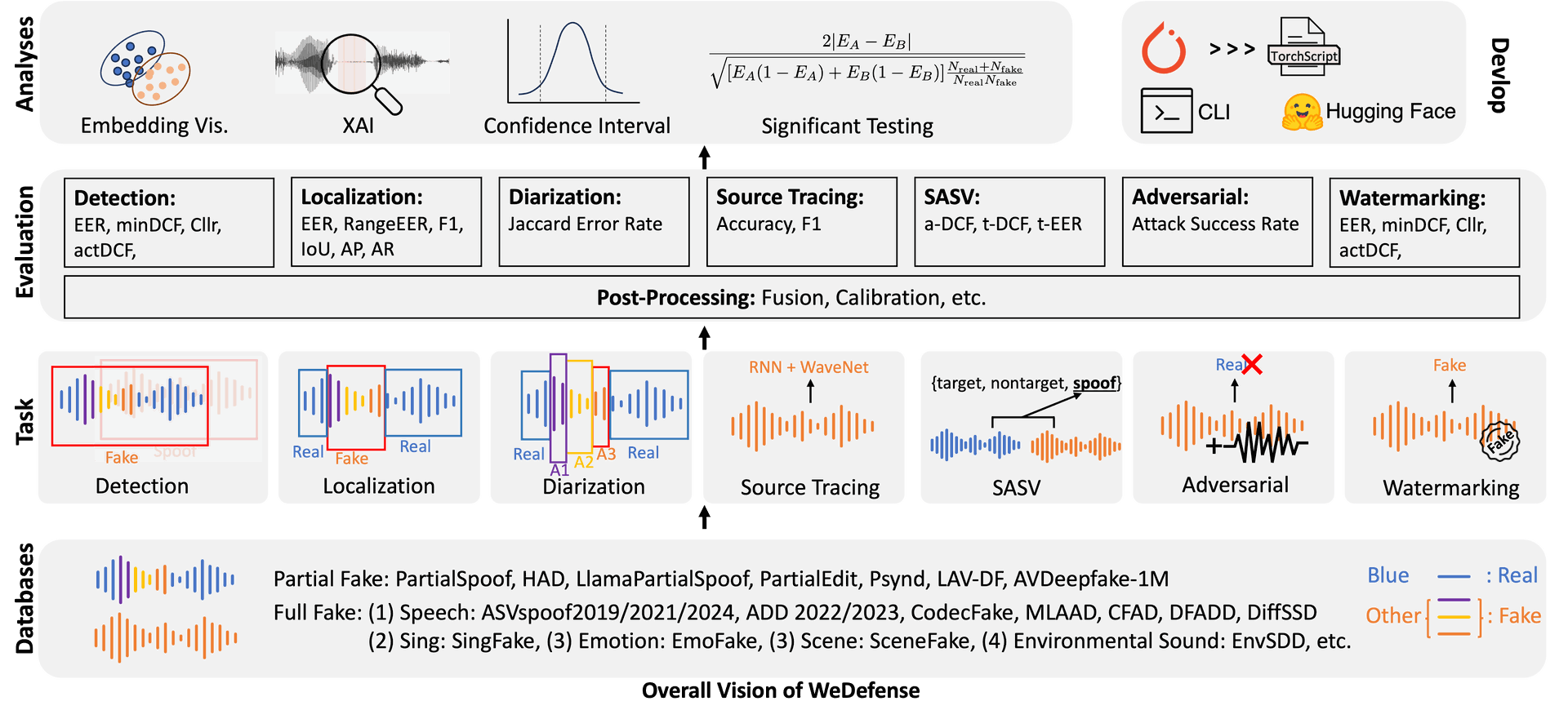
WeDefense — fake audio detection and localization pipeline. Source: zlin0/wedefense ↗
Running AI-powered detection models is left as an exercise for the reader. These tools typically require labeled training data (real vs. fake voice samples), significant compute for model training, and/or GPU hardware for reasonable performance. The links above are a starting point for teams ready to invest in building a detection pipeline.
Procedural Defense
No technology needed — these are process-based defenses that any organization or family can implement immediately. Voice cloning attacks don't just target companies — they target your parents, grandparents, and kids too.
Callback Verification
JP Morgan — When Callbacks Go Wrong ↗Challenge Questions
NIST SP 800-63B — Authentication Guidelines ↗Family Code Words
National Cybersecurity Alliance — Safe Words in the Age of AI ↗Multi-Channel Confirmation
NIST SP 800-63B — Out-of-Band Authenticators ↗Organizational Controls
Build a culture of security awareness so staff can recognize and respond to voice-based social engineering.
Security Awareness Training
KnowBe4 — Security Awareness Training ↗No Voice-Only Auth for High Value
Fourscore Law — Wire Transfer Best Practices ↗Voice Biometric + PIN
NIST SP 800-63B — Digital Identity Guidelines ↗Audit Suspicious Calls
CISA — Avoiding Social Engineering Attacks ↗Spectral Artifacts to Look For
Metallic shimmer
Vocoders leave unnatural energy above 8kHz — natural speech rolls off smoothly, AI shows a bump in the high range
Natural
AI-Generated
Phase breaks
Audible glitches or pops where audio segments are stitched together at boundaries
Natural
AI-Generated
Flat F0 (pitch)
AI voices lack the natural rise and fall of human speech melody — questions should rise, statements should fall, emphasis creates peaks
Natural
AI-Generated
No ambience
AI audio has an unnaturally clean noise floor — real recordings always have some room tone or background hum
Natural
AI-Generated
Unnatural pauses
TTS breathing and pause patterns feel mechanical — pauses are too uniform and breaths are missing or perfectly timed
Natural
AI-Generated
Smooth formants
AI over-smooths the transitions between vowel resonance bands (F1, F2, F3). Natural speech has sharp, quick shifts between sounds.
Natural
AI-Generated
Check Your Understanding
Question 1 / 5
Why is voice biometrics alone insufficient?